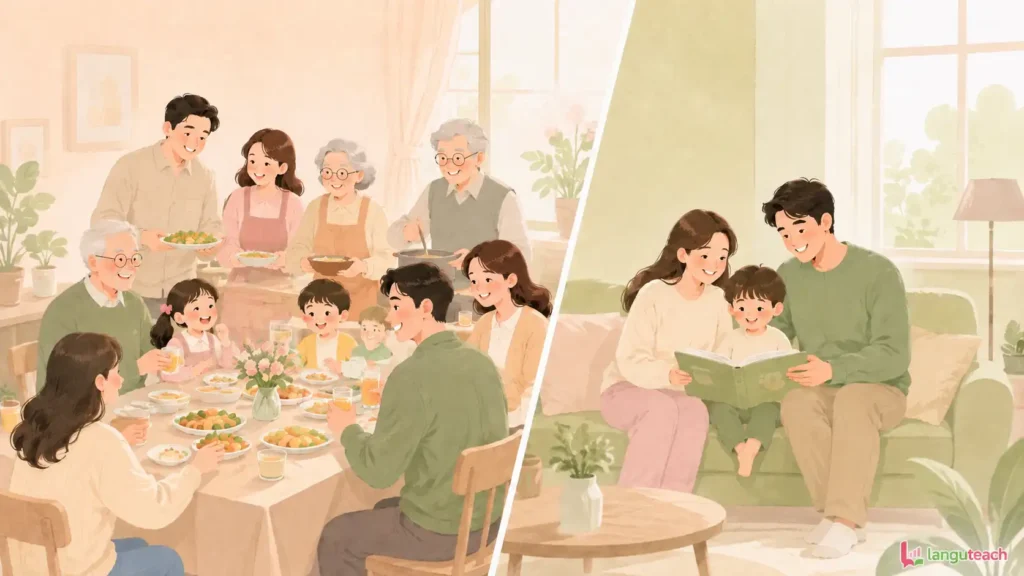
Nuclear family
Meaning
A family consisting of parents and their children.
Example
“Adam grows up in a nuclear family with his parents.”
Explore the IELTS question “Big Family or Small Family?” with topic ideas, useful vocabulary, natural collocations and guided practice for discussing Family.
Follow four clear steps to turn the podcast into active IELTS practice.
Read the pre-listening task and try to answer the questions using your own words, ideas and experience before you hear the episode.
Prepare your ideasListen to the podcast attentively. If necessary, listen more than once so you can catch key ideas, useful language and supporting details.
Play the episodeWork on the vocabulary, grammar and sentence structures in the worksheet to reinforce what you heard and use it actively.
Use the worksheetReturn to the original questions and answer them again with better vocabulary, clearer structure and more developed ideas.
Try the questions againUse your own words and experience. The goal is to activate your ideas before you hear the podcast lesson.
Keep a sheet of paper beside you. Write down your first answers before listening. After you finish the episode and worksheet, compare your new ideas with what you wrote at the beginning.
Build your Big Family or Small Family idea bank before answering the worksheet questions.
Do you come from a big family or a small family?
What do you enjoy most about your family?
If you could choose, would you prefer to grow up in a big family or a small family? Why?
Listen once for the main message. Then replay the episode while following the transcript to notice details and useful language.
Follow the transcript while replaying the audio to notice pronunciation, idea development and useful IELTS language.
Read the full podcast transcript for “Big Family or Small Family?” and follow the ideas, vocabulary, and examples step by step.
🌉 The Big Question
If you could choose your family before you were born…
What would you choose?
Would you like to be an only child?
Would you like one brother or sister?
Or would you choose to grow up with four or five siblings?
Take a moment and think about it.
Don’t answer too quickly.
Because every family gives us something…
and every family asks us to give something in return.
A small family might give you more privacy.
A large family might give you memories that last forever.
So…
Which one would you choose?
Today, let’s explore both sides.
🌱 The Quiet House
Let’s imagine two children.
The first child is called Adam.
Adam grows up in a small nuclear family.
It’s just him and his parents.
He’s an only child.
Every morning he wakes up in his own bedroom.
He enjoys plenty of personal space and doesn’t have to share his toys, books, or computer with anyone.
If he wants to study, the house is usually quiet.
If he wants to relax, he has all the privacy he needs.
His parents can give him their undivided attention.
When he has a problem at school, both parents have enough time to listen carefully.
They can also invest in his education by paying for language courses, music lessons, sports clubs, or other activities that create valuable educational opportunities.
Because there is only one child, the family’s financial resources are focused on him.
His parents also spend plenty of quality time with him, whether they’re travelling, reading together, or simply talking over dinner.
At first, this sounds like the perfect childhood.
But let’s think a little deeper.
When Adam comes home after school…
who does he play with?
Who does he tell his secrets to?
Who makes him laugh when he’s having a bad day?
Sometimes…
no one.
Many only children occasionally feel lonely.
They may lack companionship, especially during weekends or school holidays.
They don’t experience those everyday moments that brothers and sisters often share—arguing over the TV remote, laughing at silly jokes, or solving little disagreements together.
Growing up alone can be peaceful…
but sometimes…
peace can feel a little quiet.
🌳 The Noisy House
Now let’s meet Sara.
Sara grows up in a large family.
She has two brothers, an elder sibling who always gives her advice, and a younger sibling who follows her everywhere.
Life in her house is rarely quiet.
Someone is always talking.
Someone is always laughing.
Someone is probably arguing too!
Unlike Adam, Sara doesn’t have much privacy.
She has to share a bedroom with her sister.
She shares books, toys, clothes, and sometimes even her parents’ attention.
Because there are several children, her parents have to divide their financial resources carefully.
Sometimes the children even compete for attention, especially when everyone wants to tell a story at the dinner table.
Living with many people can occasionally lead to family conflicts.
And yes…
there might even be a little sibling rivalry.
That’s completely normal.
But here’s something interesting.
Every challenge teaches Sara something.
She learns teamwork because nothing gets done alone.
She learns cooperation because everyone has different opinions.
She learns to compromise because she can’t always have things her own way.
She also learns to share responsibilities.
Perhaps today it’s her turn to wash the dishes.
Tomorrow it’s her brother’s turn.
Little by little, these daily experiences prepare her for adult life.
Most importantly, Sara develops a strong family bond with her brothers and sisters.
She grows up surrounded by a wonderful sense of companionship.
When she’s worried about an exam, her elder brother helps her study.
When her younger sister is upset, Sara comforts her.
They look after one another.
They celebrate birthdays together.
They solve problems together.
And as the years pass, many of those siblings become lifelong friends who continue supporting one another throughout adulthood.
Maybe that’s why people often say…
“Your siblings are your first friends.”
💭 So… who had the better childhood?
It’s difficult to answer, isn’t it?
Adam enjoyed peace.
Sara enjoyed companionship.
Adam had more personal space.
Sara had stronger family bonds.
Adam received more individual attention.
Sara learned teamwork and cooperation every single day.
Neither childhood was perfect.
Neither childhood was wrong.
Because happiness doesn’t depend on the size of your family.
It depends on the love, support, and understanding that family members share with one another.
Whether you grow up in a small family or a large one, what truly matters is having people who encourage you, care about you, and make you feel that you belong.
🧠 Let’s Build Our Idea Bank
Before we finish, let’s summarize the main ideas we’ve explored today.
A small family may offer:
However, an only child may sometimes:
On the other hand, a large family may involve:
But it also helps children:
🎤 Your Turn
Now I’d like you to answer these questions.
Do you come from a big family or a small family?
What are the advantages of your family?
If you could choose, would you change anything? Why or why not?
Try to use today’s vocabulary naturally in your answer.
Don’t worry about being perfect.
Just focus on expressing your ideas.
Complete each part in order to turn the episode into active vocabulary, idea and comprehension practice.
Collect useful words, collocations, model sentences and grammar from the lesson.
Learn key Big Family or Small Family Vocabulary with simple, powerful words from the podcast.
A family consisting of parents and their children.
“Adam grows up in a nuclear family with his parents.”
A family that includes grandparents, uncles, aunts, cousins, and other relatives.
“During holidays, my entire extended family gathers at my grandmother's house.”
A child with no brothers or sisters.
“Adam is an only child, so he enjoys plenty of personal space.”
Brothers and sisters.
“Sara has three siblings, and they always help one another.”
An older brother or sister.
“Sara's elder sibling helps her with her homework.”
A younger brother or sister.
“She enjoys looking after her younger sibling.”
A space where you can be alone and feel comfortable.
“Having my own bedroom gives me more personal space.”
The ability to be alone without interruption.
“Teenagers often value their privacy.”
Attention given to one person instead of a group.
“Small families often allow parents to give more individual attention to each child.”
Giving someone your complete focus.
“Parents should give children their undivided attention when they need help.”
The money available to support a family.
“Some parents have enough financial resources to invest in their children's education.”
Spend time or money helping a child learn.
“Many parents are willing to invest in their child's education.”
Chances to learn or develop new skills.
“Living in a city often provides better educational opportunities.”
Time spent together doing meaningful activities.
“We always have dinner together because it gives us quality time as a family.”
Disagreements or problems between family members.
“Living with many people can occasionally lead to family conflicts.”
Competition or jealousy between brothers and sisters.
“There might even be a little sibling rivalry.”
A strong connection between family members.
“Sara develops a strong family bond with her brothers and sisters.”
The feeling of having someone with you and not being alone.
“Sara grows up surrounded by a wonderful sense of companionship.”
Working together with other people.
“She learns teamwork because nothing gets done alone.”
Working with others and accepting different opinions.
“She learns cooperation because everyone has different opinions.”
Accepting that you cannot always have things your own way.
“She learns to compromise because she can't always have things her own way.”
Divide duties or tasks among people.
“She also learns to share responsibilities.”
Care, comfort, and help during difficult times.
“Children can receive emotional support in a large family.”
Take care of each other.
“They look after one another.”
Friends who stay close throughout life.
“Many siblings become lifelong friends.”
Pick up natural Big Family or Small Family collocations from the podcast.
A space where you can be alone and feel comfortable.
“Having my own bedroom gives me more personal space.”
More ability to be alone without interruption.
“A small family may offer greater privacy.”
Attention given to one person instead of a group.
“Small families often allow parents to give more individual attention to each child.”
Giving someone your complete focus.
“His parents can give him their undivided attention.”
The money available to support a family.
“Because there are several children, her parents have to divide their financial resources carefully.”
Spend time or money helping a child learn.
“They can also invest in his education by paying for language courses.”
Chances to learn or develop new skills.
“Activities that create valuable educational opportunities.”
Time spent together doing meaningful activities.
“His parents also spend plenty of quality time with him.”
Not have someone to spend time with or share experiences with.
“They may lack companionship, especially during weekends or school holidays.”
Use the same bedroom with another person.
“She has to share a bedroom with her sister.”
Try to get noticed or listened to more than others.
“Sometimes the children even compete for attention.”
Disagreements or problems between family members.
“Living with many people can occasionally lead to family conflicts.”
Competition or jealousy between brothers and sisters.
“There might even be a little sibling rivalry.”
Learn how to work together with other people.
“She learns teamwork because nothing gets done alone.”
Learn to work with others and accept different opinions.
“She learns cooperation because everyone has different opinions.”
Learn to accept that you cannot always have things your own way.
“She learns to compromise because she can't always have things her own way.”
Divide duties or tasks among people.
“She also learns to share responsibilities.”
A close and strong connection between family members.
“Sara develops a strong family bond with her brothers and sisters.”
The feeling of having people around you and not being alone.
“She grows up surrounded by a wonderful sense of companionship.”
Care, comfort, and help during difficult times.
“Children can receive emotional support in a large family.”
Take care of each other.
“They look after one another.”
Friends who stay close throughout life.
“Many of those siblings become lifelong friends.”
Discover memorable Big Family or Small Family golden sentences you can use in real IELTS answers.
“One advantage of growing up in a small family is _____________________________.”
Use to talk about small family advantages.
“One disadvantage of being an only child is _________________________________.”
Use to talk about only child disadvantages.
“Children from large families often learn _________________________________.”
Use to talk about large family benefits.
“In my opinion, the size of a family is less important than _____________________.”
Use to give a balanced personal opinion.
Turn what you heard into reusable support for future Speaking and Writing answers.
Write down two or three important viewpoints or arguments from the episode in your own words.
Keep one useful reason, example, comparison or consequence that makes each idea more convincing.
Note which Speaking or Writing question each idea could help you answer in the future.
Compare your progress: When you finish, compare this ideas bank with the answers you wrote before listening. Notice which ideas are now clearer, stronger or more detailed.
Use the vocabulary, ideas and sentence structures you collected to create a stronger second version of your answers.
Answer the same questions again on your paper. Then compare both versions and look for stronger vocabulary, clearer organisation and better-developed support.
Move to the previous or next episode, or choose another IELTS podcast lesson related to Family.